
excl. VAT
Bathrooms
Features
- ✓ Fully refurbished unit
- ✓ Separate ladies and gents sections off a central corridor
- ✓ 2 x WC, 1 x urinal, 2 x hand basin with water heater
- ✓ 2 x shower room with electric shower and extractor fan
- ✓ Heated changing space in each section
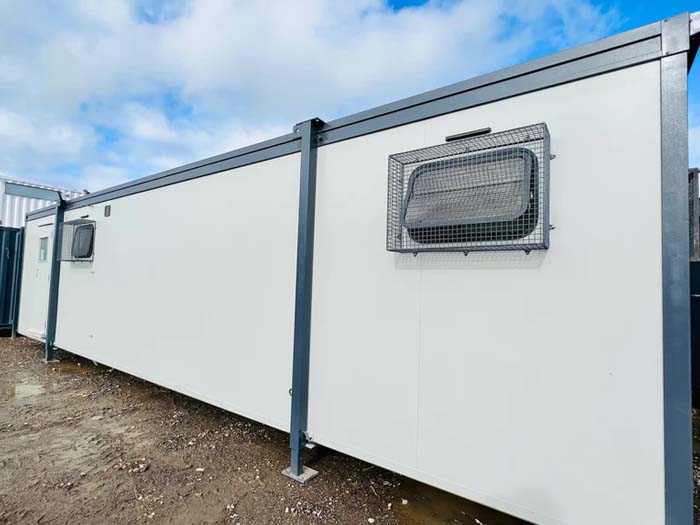
- ✓ Jack-leg unit, steel clad, 5 windows with mesh guards
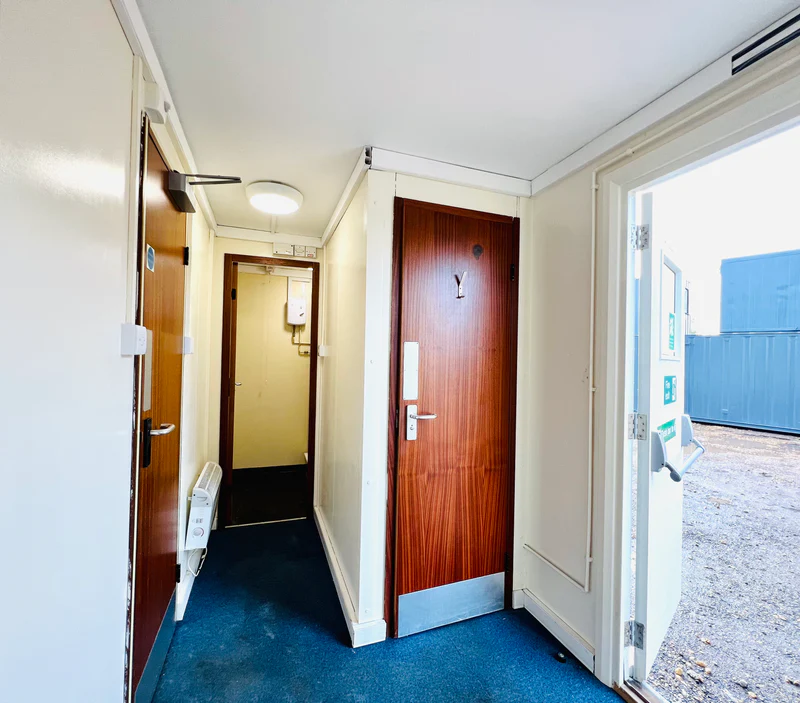
- ✓ Fire exit door in the ladies section
- ✓ 3-phase power required
Order online
€12,900.00 excl. VAT · Shipping €750.00 (Side lifter)
Pay by bank transfer (bank details shown immediately after ordering) or by card / wallet via Stripe. Up to 10 units can be ordered directly; larger quantities on request.
What a portacabin toilet and changing block does on a site
A portacabin toilet and changing block is a single movable building that gives a workforce, a sports club or an event the sanitary facilities that regulations and common decency require: toilets, hand washing, showers and a warm, dry place to change. This unit is a fully refurbished cabin on jack legs, steel clad, light grey with dark grey detailing, and divided into a ladies' section and a gents' section that never share a room. It arrives in one piece, is levelled on its legs or set onto a base, connected to power, water and drainage, and is in use the same day.
It is sold as refurbished, which means exactly that: the shell has worked before, and everything inside it has been checked and replaced or refinished where necessary during the refurbishment. That is why it costs a fraction of a newly built block of the same size, and why the description below is of the unit as it stands rather than of a catalogue drawing.
Layout, room by room
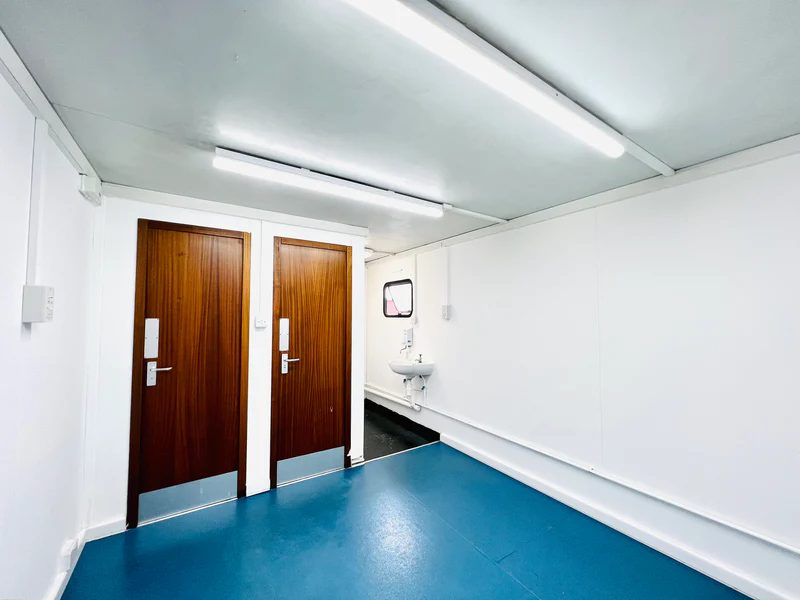
The main entrance door sits in the end panel and opens into a central corridor. The corridor has one window and one light tube, and two internal doors: one into the ladies' facilities, one into the gents'. That corridor is the feature that makes the block work for mixed workforces and public events. Nobody passes through the other section to reach their own, and a single lockable outer door secures the whole building overnight.
Ladies' section. A wash room with a WC and a hand basin fed by a water heater. A shower room with a single electric shower cubicle, its own boiler and an extractor fan. A changing space with a wall heater, one window and three lights. The three-phase consumer unit for the whole building is mounted in this changing space. A fire exit door gives a second way out.
Gents' section. A WC room, a urinal and a hand basin with a water heater. A shower room with a single electric shower cubicle and an extractor fan. A large changing space with three windows and a wall heater, and five lights across the section.
Outside. Five windows, each protected by a wire mesh guard. One end-panel entrance door with locking keys. Steel cladding throughout. The jack-leg frame that lets the unit be loaded without a crane.
Why a jack-leg cabin matters
Most container-based sanitary units need a crane at both ends of every move. A jack-leg unit does not. Its four legs are wound down to lift the body clear of the ground, a flatbed reverses underneath, the legs are wound up and the cabin sits on the truck bed. At the destination the sequence runs in reverse. Where the truck carries its own loader crane the unit can also be lifted conventionally, but the jack legs mean that a hire crane, its access requirements and its cost drop out of the move. For a sports club that relocates its facilities between pitches, or a contractor moving from phase to phase, that changes the economics of owning the block rather than hiring plastic cubicles every season.
The legs also solve levelling. Uneven ground is corrected by winding each leg independently until the floor is level and the doors swing true. Timber or concrete pads under the feet spread the load on soft ground.
Water, waste and power
Three connections bring the block into service. A cold water feed supplies the basins, the showers and the WCs; the water heaters and shower boilers raise the temperature locally, so no external hot water supply is needed. Waste from the WCs, urinal, basins and showers falls to outlets under the floor, which connect to a foul drain where one exists or to a holding tank that is pumped out on a schedule. Events and remote sites usually run on a tank; long-term site compounds are better served by a drain connection.
Power is three phase. Two electric showers, two shower boilers, two basin water heaters, two wall heaters, extractor fans and lighting add up to a load that a single-phase site supply cannot carry safely. The consumer unit is installed and the block is wired; on site an electrician terminates the incoming supply under local regulations. Where a three-phase supply is not yet available, the connection should be arranged before the delivery date is fixed, because it is the one item that cannot be improvised on the day.
Ventilation and hygiene
Each shower room has its own extractor fan, which is what keeps a small wet room from turning into a condensation problem. The windows in both changing spaces open for background ventilation. Wall panels are wipe-down surfaces and the flooring is a sealed sheet material that is mopped rather than scrubbed. For daily cleaning the layout helps: two compact wet zones and two changing spaces, each reachable from the corridor, so a cleaner works through the building without doubling back.
Heating and comfort
A changing room in February is judged by one thing: whether it is warm when people arrive wet and cold. Each changing space has a wall-mounted heater, and the small volume of the rooms means they come up to temperature quickly. The shower boilers and basin heaters are local, so hot water is available without waiting for a central tank to recover. Windows with mesh guards let in daylight while keeping the glass safe from stray balls and site traffic.
Where a portacabin toilet and changing block is used
- Construction and civil engineering sites where separate facilities for women and men, with showers, are a condition of the contract or the law.
- Sports grounds without a clubhouse, or clubs whose clubhouse is being rebuilt. Two teams change in the two sections; the referee uses the corridor door.
- Festivals, markets and seasonal events that want a sturdier and more pleasant option than plastic cubicles for staff, performers or exhibitors.
- Farms, quarries, forestry and wind farm sites where the nearest building with a shower is a long drive away.
- Emergency response, where a delivered, lockable block with showers restores dignity to a temporary camp within hours.
Refurbished versus new
| Aspect | This refurbished block | New-build equivalent |
|---|---|---|
| Price | Well below a new block of similar layout | Full new-build cost |
| Availability | Existing unit, ready when transport is arranged | Manufacturing lead time |
| Layout | Fixed as described; adaptable within limits | Drawn to order |
| Fittings | Checked, replaced or refinished during refurbishment | All new |
| Transport | Jack legs, no crane needed with a suitable truck | Depends on chassis; container units need a crane |
Siting and ground preparation
The block needs a firm, reasonably level standing with a clear approach for a flatbed truck. Hard standing, compacted stone or firm grass in dry conditions all work; soft ground needs pads under the feet. Site the unit with the entrance door facing the direction people arrive from and with the waste outlets on the side nearest the drain or tank position. Leave working space on the tank side for the pump-out vehicle. Where the block will stand for more than a season, a gravel apron around the doors keeps mud out of the changing rooms and off the floors.
Maintenance
Routine care is the same as for any small sanitary building. Descale shower heads and taps on a schedule set by the local water hardness. Check that extractor fans run and that their external grilles are clear. Inspect door and window seals annually and replace them when they harden. Wash the steel cladding and touch up any chips in the paint before corrosion gets a foothold. Winterising a block that will stand unheated means draining the water heaters, boilers and pipework, because a burst heater is the single most expensive avoidable repair in units of this kind.
Ordering and delivery
Ask for the current photographs of the unit, the connection positions and the loaded weight for transport planning. Delivery and off-loading are arranged through our haulage partners to any address; alternatively the block is loaded onto your own vehicle by forklift at the depot. State the destination, the standing, the access route and whether a three-phase supply exists when you enquire, and the quotation can cover transport and connection scope accurately. Many more containers, portable offices, toilet blocks and welfare units are available if this portacabin toilet and changing block is close to what you need but not exact.
Frequently Asked Questions
What power supply does the toilet and changing block need?
A three-phase supply. Two electric showers, two shower boilers, two basin water heaters, two wall heaters, the extractor fans and the lighting add up to more than a single-phase site feed can carry safely. The consumer unit is mounted in the ladies' changing space and the building is wired; an electrician terminates the incoming supply on site under local regulations.
Does the block need a drain connection?
It connects to a foul drain where one exists, or to a holding tank that is pumped out on a schedule where none does. Events and remote sites usually run on a tank; a long-term site compound is better served by a drain. It also needs a cold water feed. All outlets and the inlet are on the underside of the unit.
What does refurbished mean for this unit?
The cabin has been through a full refurbishment inside and out. Sanitary fittings, heaters, boilers, lighting, flooring, seals and the exterior cladding and paint were checked and replaced or refinished as required. It is a used shell returned to working order, priced accordingly, and it is described here as it actually stands.
How is a jack-leg cabin moved?
The four legs are wound down to lift the body clear of the ground, a flatbed reverses underneath, the legs are wound up and the cabin rests on the truck bed. At the destination the sequence is reversed. No hire crane is needed when the truck is suitable. We arrange delivery and off-loading, or you collect from the depot.
Can the block be used by two teams at once?
Yes. The ladies' and gents' sections are separate rooms off a central corridor, each with its own WC, basin, shower and changing space, so two groups can use the building at the same time without passing through each other's area. Sports clubs use exactly that arrangement for home and away teams.